


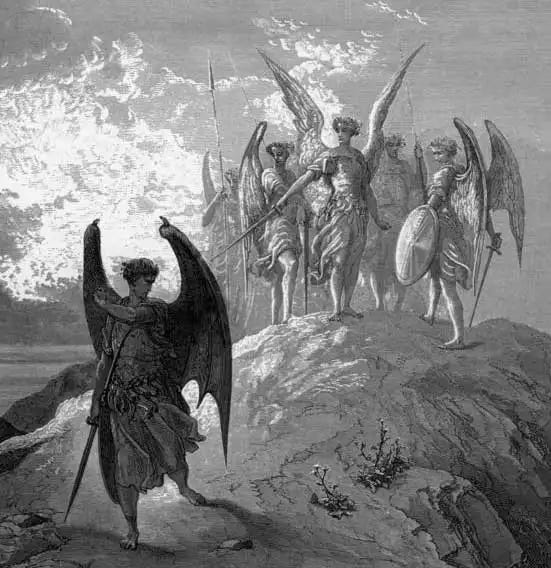
[First, a due thanks to my friend Melanie Henry for the editing! It improved the essay so much!]
The Watchers story is, at heart, an argument about who owns legitimate knowledge in a world shaped by Mesopotamian prestige. In the Enochic retelling, Enoch becomes the authorized heir of cosmic science, while Mesopotamian-coded expertise is recast as the legacy of rebellion.
Introduction:
Genesis 6:1–4 is one of those deceptively short biblical passages that behaves like a crack in a wall: press on it even lightly, and an entire hidden architecture begins to show. I’ll add the text so you don’t have to check on it:
When human beings began to increase in number on the earth and daughters were born to them, the sons of God saw that the daughters of humans were beautiful, and they married any of them they chose. Then the Lord said, “My Spirit will not contend with humans forever, for they are mortal; their days will be a hundred and twenty years.” The Nephilim were on the earth in those days — and also afterward — when the sons of God went to the daughters of humans and had children by them. They were the heroes of old, men of renown.
A few lines about the “sons of God,” human women, and the Nephilim become, within Second Temple Judaism, the sprawling myth of the Watchers: heavenly beings who descend, transgress boundaries, teach dangerous arts, father giants, and unleash a demonic afterlife that continues to haunt the world. In that framework, the Flood becomes not merely a judgment on human violence, but a cosmic cleanup after a catastrophic breach.
What is easy to miss is what kind of “sin” the Enochic tradition is really interested in. Sex is there, loudly. Violence follows. But the engine of the narrative, the thing that makes the Watchers myth feel like an origin story for history going wrong, is knowledge: secret arts, technical mastery, ritual technologies, and the question of who is allowed to hold them.
This leads directly into what Amar Annus calls the “Mesopotamian problem.” Ancient Israelite scribes and intellectuals lived in a world where Mesopotamia could claim, with real cultural authority, to be older, more “civilized,” and the custodian of prestigious priestly and scholarly knowledge. The Enochic Watchers story reads, in Annus’s account, as a deliberate inversion: the claim that “our arts are antediluvian, powerful, and authoritative” is preserved, but its moral sign is flipped. What was once glorious wisdom becomes illicit, destabilizing disclosure.
What follows is a guided walk through how that inversion works: how the Watchers myth grows out of biblical ambiguity; how it targets specific kinds of expertise (metallurgy, cosmetics, incantations, astronomy); and how Mesopotamian figures like the apkallū (“sages”) sit behind the Watchers as both template and foil.
1) Genesis 6:1–4 as a narrative “spark”
Before Enoch, Genesis 6:1–4 gives a compressed tableau: sons of God, daughters of men, abnormal unions, offspring of renown, and the Nephilim. The problem is that the text does not explain itself. It leaves identity (divine beings? human elites?), causality (why is this wrong?), and even the relationship between the unions and the Nephilim frustratingly open.
That density (and ambiguity) is exactly why the passage generated so many expansions. Modern scholarship usually maps three classic interpretative families: the mythic reading (divine/angelic beings), the royal reading (tyrannical rulers or kings), and the Sethite reading (intermarriage between Seth’s line and Cain’s line). Whatever option one favors, the passage functions as a hinge: it sits at the threshold of the Flood narrative and signals that disorder is intensifying.
But Genesis 6 itself does not tell you what kind of crisis this is. It gives the image of boundary-crossing (or trespassing) and hints at abnormal consequences, without spelling out why this episode matters enough to stand on the threshold of the Flood. The Enochic writers offer a bold answer: because the boundary crossing wasn’t only sexual or social; it was a matter of knowledge.
Genesis provides the provocation. The Enochic tradition builds the infrastructure.
2) Enoch’s solution: turn the fall into a knowledge crisis
1 Enoch 6–11 is already a composite, most clearly a Shemihazah narrative and an Asael narrative knitted together into a single mythic argument. The text is too long to be added, but you can read it here (chapter 6 through 11).
The familiar headline (angels take wives) is not the story’s real engine. The engine is what comes next: teaching. The Watchers transmit sorcery and spellbinding and other illicit arts, and the resulting world is not merely immoral but structurally destabilized. Violence scales up. Social boundaries blur. The earth becomes unlivable. In this framework, the myth becomes an explanation not just for moral decline, but for how corruption spreads as if it were contagious.
This shift transforms the cryptic episode in Genesis 6 into a master explanation for the world’s corruption and, crucially, into a story about the origin and legitimacy of knowledge. Once you read the myth this way, the Mesopotamian background stops being decorative and becomes explanatory. Mesopotamia had a highly developed culture and imagination about revealed science, priestly expertise, and the management of dangerous ritual power. The Watchers story reads plausibly as a myth of leaked expertise: what happens when specialized knowledge breaks containment, bypasses legitimate channels, and spreads outward with no authorization.
Annus’s summary captures the contrast sharply:
Mesopotamian master narrative (as perceived by Jewish intellectuals): the arts and scholarly disciplines are antediluvian, powerful, guarded, and tied to prestigious sage-figures.
Enochic counter–narrative: angels reveals “secrets” that should stay confined; the disclosure produces moral and material catastrophe; Enoch’s ascent and authority displace the authority of foreign sages.
In first-millennium Mesopotamia, learned arts: divination, exorcism, ritual, astronomy, medicine, were not imagined as freely circulating information. They were restricted, guarded within court and temple milieus and often marked as secret lore for specialists. Mesopotamian scholarly ideology could even speak of secrets of the scholars and secrets of the antediluvian sages, emphasizing controlled transmission and the exclusion of the uninitiated.
Against that background, the Watchers myth reads plausibly as one of forbidden expertise; a narrative that answer what happens when specialized knowledge breaks from its containment, bypasses legitimate channels, and spreads outward with no social or cosmic authorization. This is the kind of disorder many rebellion myths explore: an inversion of hierarchy, where something reserved for the divine realm (or for properly bounded experts) is seized, traded, or exposed (see for example my previous article on Lucifer, and the myth about Aththar trying to take the throne of Baal in his absence). In Enoch, that breach is inseparable from a second boundary violation: the Watchers go in to human women, defile themselves, and in the same movement teach their arts, so that illicit knowledge arrives in the world already charged with impurity, taboo, and escalating violence.
This is the inversion: the antediluvian origin of the arts is retained, but it is now framed as a scandalous breach rather than a glorious pedigree. When a master narrative becomes oppressive (culturally embarrassing, politically humiliating, or identity-threatening), a counter–narrative can reassign moral agency and prestige.
So the Watchers story can be read as saying something like:
Yes, the arts come from antediluvian times.
Yes, they are powerful.
Yes, they are linked to beings above ordinary humanity.
But that’s the problem, not the boast. The origin is tainted; the transmission is illicit; the results are violent.
3) Mesopotamia’s antediluvian wisdom system: kings, sages, and the Apsû
Annus’s On the Origin of Watchers makes the comparative claim in a focused way. The Watchers tradition participates in a broader antediluvian-wisdom complex, where “before the Flood” is not merely early time but authoritative time: the era when the most powerful knowledge entered human history, mediated by figures such as the apkallū (primeval sages).
Apkallū: sages of the deep
In Mesopotamian imagination, apkallū are fish-garbed beings associated with Ea/Enki and with the Apsû, an ocean of wisdom1.
Without forcing exact one-to-one identifications, the resemblance is striking at the level of narrative structure: a nonhuman mediator class, positioned between divine domain and human society, linked to knowledge transmission.
Enmeduranki and the logic of authorized revelation
Fröhlich emphasizes that Enoch’s revelation profile makes sense against Mesopotamian patterns of mantic and mythological lore, pointing to the revelation tradition associated with Enmeduranki.
In Mesopotamian tradition, Enmeduranki is remembered as a primeval (antediluvian) king whose authority rests on a very specific kind of initiation: the gods entrust him with heavenly secrets (often imagined as tablets and priestly mysteries) and he becomes a model for how high knowledge is meant to enter human history: through a chosen mediator and through controlled, authorized transmission, rather than through open disclosure. That profile matters for the Watchers story because the Enochic writers are not rejecting the Mesopotamian prestige-idea of antediluvian revelation; they are competing for it. Ida Fröhlich explicitly points to the revelation tradition associated with Enmeduranki as a key Mesopotamian backdrop that makes Enoch’s revelatory identity clear, precisely because it provides an older template for “cosmic science” delivered to a legitimate recipient.
And Orlov stresses the same axis from the Enoch side: Enoch is shaped as a primeval sage whose role as visionary/scribe and transmitter of secrets maps onto an ancient Near Eastern pattern associated with figures like Enmeduranki, so that, in the Enochic counter–narrative, authorized wisdom is relocated from the Mesopotamian sage-king tradition to Enoch as the rightful heir of heavenly knowledge.
The important point is simple: Mesopotamia had strong models for the idea that a chosen antediluvian figure receives the secrets of heaven from divine sources.
The Enochic tradition doesn’t reject that model. It competes for it.
4) From sages to sinners: the Enochic “flip” is not random
If Mesopotamia offers a wisdom system, why would Jewish writers turn its mediators into villains?
Annus gives a crucial clue: Mesopotamian traditions themselves contain ambivalence. Apkallū are predominantly positive, but they can also take on a darker side. They are part of those uncanny beings who in some cases are counted among the demonic, or the subjects of anti-witchcraft magic.
Annus presses the point further: the wickedness of antediluvian teachers in Enoch is not purely an external reversal; it aligns with currents already present in Mesopotamian demonology.
Even more importantly, Mesopotamian literature includes a motif of sending sages down and forbidding their return. Annus cites the Erra Epic version in which Marduk sends the sages back to the Apsû in a way linked with the Flood.
This matters because it shows why the Enochic story could feel right in a Mesopotamian-saturated world. The writers did not have to invent the notion of primeval mediators who end up confined; they could repurpose a motif already available.
And once the Watchers’ knowledge become “wrong knowledge in the wrong hands”, Enoch becomes the narrative solution: right knowledge, transmitted legitimately, under supervision, to the right figure.
Orlov’s work on the “seventh antediluvian hero” is central here. He traces how Enoch’s roles (visionary, scribe, mediator of secrets, transmitter to posterity) map onto a broader ancient Near Eastern pattern associated with figures like Enmeduranki, who receives divine tablets and priestly mysteries and passes them along through authorized lines.
This is the axis Annus highlights: the counter–narrative does not abolish the prestige of antediluvian knowledge; it relocates it. Enoch replaces Adapa/Oannes (and, by extension, the Mesopotamian sage-claim) as the exalted mediator whose ascent and authority reorder the intellectual cosmos.
5) Why the name Watchers lands: guardianship and the irony of failure
One of the most striking bridges in Annus’s study is the ritual background of watching-as-guarding.
He notes that apkallū figurines were buried as foundation deposits to avert evil from houses and that Akkadian incantations use the term maṣṣarū,(watchers or guards), for these sets of protective figurines.
This matches the Aramaic term ʿîrîn (wakeful ones), used both for good angels and for the Watchers.2
You don’t need to force this into a single-line etymological proof. The payoff is conceptual:
Mesopotamia had a strong ritual sense of guardians stationed to protect thresholds.
Enoch takes a guardian class and tells a story about guardian betrayal.
That betrayal is part of what makes the myth potent. It’s not simply “angels sinned.” It’s that the beings meant to uphold order become the origin point of disorder.
6) Giants as demonic ecology: not warriors, but a plague on creation
The Watchers myth does not stop at transgression. It escalates into an ecological catastrophe: the Giants devour, destroy, and bleed the world.
Fröhlich makes a compelling Mesopotamian connection: the Giants’ traits evoke the tradition of utukku, a term broadly used for demonic beings. The Giants are tall, roaming in bands, indiscriminately attacking victims, ravaging human work, devouring flesh, and consuming blood.
That portrait shifts the Giants away from heroic titans and toward something more like a demonic force of devastation: a mythic explanation for why the world becomes uninhabitable.
Drawnel’s broader framing reinforces the same point from another angle. The resemblance is not to organized warfare, but to the helplessness of humanity and nature under demonic violence, where humans become victims rather than combatants.
In other words, the Watchers myth reads like a cosmic version of what exorcistic literature assumes: some forces don’t argue, they consume.
7) The Book of Giants and the polemics of epic memory
If 1 Enoch 6–11 is the myth’s core, the Book of Giants3 is where the Mesopotamian entanglement becomes harder to dismiss.
Annus notes that different recensions of the Giants tradition contain names such as Gilgamesh, Humbaba, and Uta-napishtim, and he cites the view that this represents a polemical thrust against revered traditions of a rival culture. He also notes Stuckenbruck’s argument that the influence is not limited to name-dropping; it shows up in the broad narrative of the Book of Giants itself.
Fröhlich adds a vivid detail: the Giants story world includes motifs tied to the demonic realm and can include dream interpretation that resonates with the Mesopotamian epic horizon.4
The takeaway is not that Jewish authors sat down with Babylonian epic tablets and “rewrote them”. It is that cultural memory of Mesopotamian primeval and epic material was present enough (especially in Aramaic contexts) to be reworked into a new mythic logic:
Mesopotamian epic: primeval figures can be liminal, powerful, sometimes heroic.
Enochic reframe: primeval liminality is reclassified as demonic abnormality destined for extinction.
One of the most distinctive Enochic moves follows from that: the giants die, but their spirits remain as destructive forces in the world. Drawnel argues that the background for this is illuminated by Mesopotamian demonological and incantation traditions where categories of malevolent spirits are described, classified, and ritually resisted.
This is where “forbidden expertise” becomes not only a social critique but an ontological one: bad knowledge changes what kinds of beings inhabit the cosmos.
8) Asael/Azazel: the myth’s most pointed critique of expertise
Personal note: As a blacksmith, metallurgist and occultist, I’ve spent a lot of time studying the cultural and religious ties of metals and its craft, so this section felt mandatory for me.
If Shemihazah gives the myth its angel fall drama*, Asael gives it its cultural bite.
(* Shemihazah is the leader of the descent: his storyline carries the mythic drama of rebellion, oath-taking, and the illicit unions that trigger the crisis. Asael (Azazel), instead, is where the story becomes concrete and socially sharp: he is the Watcher who teaches metallurgy, weapons, cosmetics, the main crafts who seems related to the ungodly behaviour of the giants, that is, voracity, violence, illicit sexual unions, etc. With the Asael narrative, the myth turns from the broader “fall from heaven motif” into a critique of how dangerous expertise reshapes human society when it escapes legitimate control.)
Drawnel’s study of Asael’s professional skills insists that 1 Enoch 8:1 is not a loose list of villainous inventions. It is anchored in Late Babylonian social reality: a world where temple institutions gathered craft, administration, and scholarship, and where certain professional groups carried prestige. 5
Drawnel explicitly describes the priestly enchanters (āšipū / mašmaššu) as a respected professional group tied to temple personnel and scholarly culture. Against that background, he argues that the Watchers myth can be read as a Jewish scribal strategy: it explains how pagan scholars could possess sophisticated knowledge not from the God of Israel, while also making space for Jewish appropriation of scientific insight by relocating legitimate revelation under Enoch and faithful angels.
Why metallurgy, weapons, cosmetics?
Asael’s signature teachings include metalworking and weapon production. Drawnel notes that the Aramaic terminology stresses making/working (repeating the verb עבד)6 with swords, breastplates, gold, and silver, pointing toward professional craftsmanship rather than generic mining.
The social logic is sharp: metallurgy is not just technology. It is power. It is temple economy (precious metals), elite display, and the infrastructure of violence. When the myth wants a concrete example of illicit knowledge that reshapes the world, it chooses the crafts that sit at the intersection of material mastery and social domination.
In Enochic logic, weapon-making collapses the boundary between skill and violence: technical mastery becomes mass harm. Drawnel emphasizes that the text frames Asael’s instruction as immediately generative of bloodshed and disorder, not as morally neutral craft. Annus’s comparative observations help contextualize why this would resonate: Mesopotamian primeval materials already entangle artisanship and divine tools; the world of sages and craftsmen is already entangled with cosmic order and its policing.
A note on cosmetics and social order
Asael’s “cosmetics” are not a throwaway detail. In the Aramaic-based tradition behind 1 Enoch 8:1, Asael’s instruction includes materials plausibly identifiable with eye-paint / antimony (stibnite)7,rendered in Greek as kalliblépharon, “paint for the eyelids and eyelashes,” a term that can also carry a medicinal nuance (a pharmakon as well as a cosmetic).
Within the myth’s logic, this matters because adornment becomes a mechanism of disorder: Asael’s crafts are immediately linked to godlessness and transgressive behavior, and one textual strand is explicit that these ornaments/cosmetics are taught in relation to women.
Read against the Mesopotamian social background Drawnel reconstructs, where temple economies concentrated luxury crafts (precious metals, stones, pigments) and where such skills were embedded in hierarchical institutional settings, cosmetics function in Enoch as more than beauty. They signal status, seduction, and the destabilizing spread of elite/ritual-material expertise outside its proper bounds, amplifying the story’s central theme: boundaries breached (sexual and epistemic) and order inverted.
9) Punishment as mythic exorcism: binding, darkness, and a legal framework
One of the most persuasive “Mesopotamian fingerprints” in the sources is the way punishment is imagined.
Drawnel argues, against proposals that the Asael narrative is mainly modeled on Greek Prometheus traditions, that the pattern of Asael’s punishment in 1 Enoch 10:4–8 is far more plausibly explained by Babylonian anti-witchcraft practices within āšipūtu (exorcistic literature). Motifs of restraint, isolation, and the removal of contaminating agency into liminal or desolate spaces are not unique to Enoch, they resonate with broader Near Eastern strategies for neutralizing malevolent forces. (See as an example, the scapegoat ritual related to Azazel).
The contrasts he highlights are concrete: Asael is not chained to a cliff and tormented by an eagle; his hands and feet are bound, he is placed in a pit in the desert, covered with darkness, prevented from seeing light, and destined for burning judgment8. If you are familiar with magical techniques, it’s easy to see parallels where bad influences or spirits are treated in a similar way. If you’re not, let me make a few examples.
Example 1 — Maqlû (Mesopotamian anti-witchcraft series)
In the Akkadian anti-witchcraft corpus Maqlû (“Burning”), the speaker explicitly reverses the witch’s attack by binding her body and limbs in words that sound strikingly close to the “bound hands and feet” motif:
“I bind your body, I tie your limbs together … I twist your sinews.”
This is exactly the same ritual imagination as Enoch’s Asael punishment: the harmful agent is neutralized by restraint, then removed from ordinary space and ultimately destined for fiery judgment (Maqlû is saturated with the logic of giving the evildoer over to the fire-god/consuming fire). You bind the evildoer, and at the same time you unbind yourself from their magic. Much as we have, in the Watchers’ narrative, the binding of Asael as a way to undo the effects of their influence (with the subsequent Flood.
To reinforce it, in another text we find:
I bind you, I tie you up, I give you over,
To Girra9 , who burns, incinerates, binds,
Overpowers and seizes the sorceress!
Example 2 — Aramaic incantation bowls (late antique Mesopotamia)
A close late-antique parallel comes from the Aramaic incantation bowls themselves: spells are written in a spiral around the interior, sometimes with a demon drawn in the center (even enclosed in a circle, or shown as chained). After the recitation, the bowl is turned upside down, explicitly “thereby trapping the demon inside”.
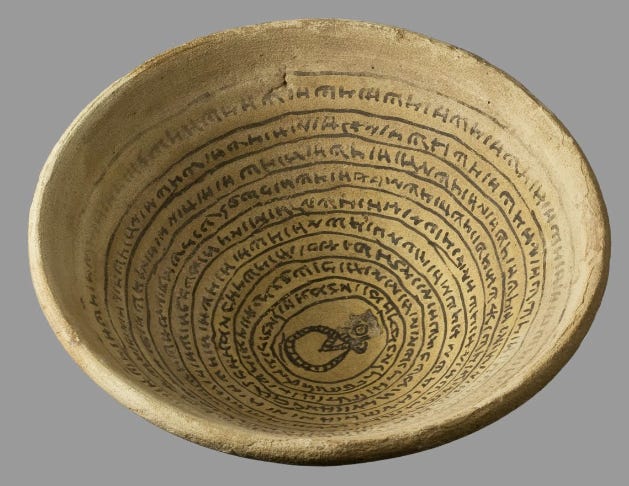
Excavation reports and bowl studies also note the same trapping logic in deposition: bowls were commonly buried upside down under floors or thresholds, and in some cases two bowls were set rim-to-rim to create an enclosed space that was then sealed.
Why anti-witchcraft matters
Drawnel’s larger claim is programmatic: the Jewish author in Late Babylonian Mesopotamia treats Asael and the Watchers as warlocks and sorcerers against whom exorcistic procedures must be applied.
This is where Fröhlich’s remarks dovetail: binding is a constant motif both in Enochic punishments (Asael bound by Raphael; Shemihazah by Michael) and in Mesopotamian demonological texts, where binding is precisely what demonic or witchcraft agency does to victims, and what ritual specialists aim to undo.
Fröhlich also notes that binding is a major motif in Enūma eliš: triumph over demonic enemies is marked by binding, and binding accompanies the reordering of the cosmos. The Watchers myth, then, presents judgment in similar terms: a cosmic-ritual act in which forces of disorder are bound and removed so the world can be stabilized.
A note on the Testament of Solomon:
The binding theme later echoes in texts like the Testament of Solomon, before entering the so-called Grimoire tradition, with lists of demons bound by angels, divine names, or other magical means. If you’re interested in how these motifs travel, it’s a surprisingly deep rabbit hole.
The legal imagination behind the ritual
Drawnel goes even deeper, highlighting the legal framework embedded in anti-witchcraft literature: in Mesopotamian rites, Šamaš, the god of justice, can function as judicial authority in a process where the victim accuses sorcerers and the gods issue binding decisions.
Even details like writing sins upon Asael (in 1 Enoch 10:8, echoing the scapegoat ritual) can be read as resonant with procedures in which the culprit’s identity and evil are symbolically fixed so they can be destroyed with the perpetrator, sparing the afflicted.
In short: punishment in Enoch looks like mythologized anti-witchcraft. It isn’t just retribution; it’s containment and elimination of a dangerous operator.
A note on contemporary Witchcraft:
When I stumbled upon these concepts, my mind run at how the myth of the fallen angels has entered into many strands of contemporary witchcraft practices. And then I thought at how the witch trials have been taken as a cornerstone, as a founding event for contemporary witches. And then it struck me that there is a parallel:
Witches —> Witch trials
Watchers —> Anti-witchraft models of trials
I find it very cool. I won’t say no more, it is something that may be food for thought for practitioners of the Craft.
10) What the Watchers myth accomplishes: a politics of origins
At this point the pieces click into place, and the Watchers myth becomes legible as more than angelology:
Mesopotamian antediluvian sages/kings traditions were known and could be deliberately inverted; apkallū could be viewed positively or negatively; sending sages down to the Apsû provides a precedent for confinement motifs; watchers language appears in ritual contexts tied to protective figurines.
Early Enochic traditions were shaped in Aramaic contexts familiar with Mesopotamian lore, and they recontextualize Mesopotamian elements into a story deeply concerned with impurity, magic, demonology, and binding.
The myth targets the prestige of Babylonian scholarly and craft culture (especially temple-linked expertise), turns expertise into culpability, and draws on anti-witchcraft frameworks to imagine how such culpability is neutralized.
Conclusion: who controls the world by controlling its skills
If we read the Watchers story only as an ancient fantasy about angels and sex, we miss its real bite. The myth is asking a question that every complex society eventually asks:
What happens when powerful expertise moves outside the structures meant to contain it?
Annus’s counter–narrative lens helps us see how Enochic writers preserve the claim that the arts are antediluvian and extraordinary, while stripping Mesopotamian sages of their moral right to that claim and relocating legitimate revelation in Enoch. Drawnel shows that the arts at stake are not vague abstractions but concrete professional domains (metallurgy, adornment, cosmetics, ritual technologies) precisely the kinds of skills that reshape social order when they spread. Orlov explains why Enoch becomes the authorized bearer of secrets: he fits a recognizable ancient Near Eastern pattern of the divinely initiated sage whose transmission is controlled rather than contagious.
So the Watchers are not merely Fallen Angels. They are an image of leaked power, knowledge unmoored from rightful hierarchy, and the world that follows them is the world after that leak: armed, enchanted, cosmetically re-scripted, ritually destabilized, and haunted by the lingering spirits of corrupted pedagogy.
A final question: So, summing up, who are the Fallen Angels?
Read against Mesopotamian tradition, the “fallen angels” are best understood as apkallū turned inside out.
In Mesopotamia, the apkallū are primeval mediators: semi-divine sages tied to the Apsû, carriers of antediluvian knowledge, sometimes even imagined as protective guardians whose presence keeps disorder away. They represent a prestigious claim: our arts are old, revealed, and authorized.
The Watchers take that same basic profile: antediluvian teachers who stand between heaven and earth, and reverse its moral meaning. They are what the apkallū become once they are demonized: From culture-bringers to culture-breakers; from wardens to betrayers and destroyers; from legitimate transmitters of wisdom to leakers of dangerous expertise.
That’s why their fall looks the way it does. It’s not only a descent from heaven. It’s a demotion of a whole category of authority. The Watchers are a polemical reclassification of the old apkallū sage template: the same kind of beings who, in Mesopotamia, guarantees civilization—recast as the beings who explains its corruption.
Bibliography
Annus, Amar. On the Origin of Watchers: A Comparative Study of the Antediluvian Wisdom in Mesopotamian and Jewish Traditions.
Annus, Amar. The Heavenly Counterparts of Adapa and Enoch in Babylonia and Israel
Annus, Amar. The Story of the Watchers as a Counter Narrative: Enochic Responses to the Authority of Mesopotamian Sages.
Drawnel, Henryk. Professional Skills of Asael (1 En. 8:1) and Their Mesopotamian Background.
Drawnel, Henryk. The Punishment of Asael (1 En. 10:4–8) and Mesopotamian Anti-Witchcraft Literature.
Drawnel, Henryk. The Mesopotamian Background of the Enochic Giants and Evil Spirits.
Drawnel, Henryk. 1 Enoch 6-11 Interpreted in Light of Mesopotamian Incantation Literature.
Fröhlich, Ida. Mesopotamian Elements and the Watchers Traditions.
Grossman, Jonathan. Who Are the Sons of God? A new suggestion.
Orlov, Andrei. The Learned Savant Who Guards the Secrets of the Great Gods’: Evolution of the Roles and Titles of the Seventh Antediluvian Hero in Mesopotamian and Enochic Traditions: Part II: Enochic Traditions.
Selz, Gebhard J. Of Heroes and Sages: Considerations on the Early Mesopotamian Background of Some Enochic Traditions.
Siqueira, Reinaldo W. The Sons of God in Genesis 6:1-4
Stuckenbruck, Loren T. The Myth of Rebellious Angels.
The Apsû is a complex and even deified element of Mesopotamian mythology, reaching back to the Sumerians. It is a chthonic place, the source of all sweet waters, where gods and beings resides. I suggest to read the wikipedia article to get familiarity with the concept.
On apkallū, Apsû, the Erra Epic confinement motif, and maṣṣarū “watchers” in ritual contexts: Annus.
The Book of Giants is basically a retelling of the story on the rebellion of the Watchers, with different details.
On Giants and utukku parallels; binding and Enūma eliš motifs: Fröhlich.
On Asael’s crafts and Late Babylonian temple/social background; Watchers myth as critique of Babylonian scholarly culture: Drawnel.
The verb written עבד is Hebrew/Aramaic ʿābad (also vocalized ʿăbad in some traditions), meaning “to work, to make, to perform.” In discussions of 1 Enoch 8:1, the point is that the list of Asael’s skills is framed not as abstract knowledge but as practical craft/production, emphasizing making/working specific items rather than merely discovering them.
Much has been said, if you’re into this, on the mention of antimony, and further connections with alchemy. It could be stibnite. However, a Facebook post by Brian Alt, who owns the Patreon Practical Theurgy (an amazing blog), has hypothesized that the mineral used for eyepaint is galena (lead sulfide), which was quite common and easily produced a black pigment.
On Asael’s punishment and Mesopotamian anti-witchcraft (legal/ritual) frameworks: Drawnel.
To make it simple, a God of fire, who also sharpens the weapons of the gods. In the next lines, he is asked, as fire, to undo all the baneful magic as fire undoes matter.
I saw Mesopotamia and came here
I Love such content.