Do not use Power Names!
Or maybe you should?

On Words of Power: A Personal Perspective
I must admit that the article’s title is a bit of a clickbait, but it was written in good faith. After a period of silence, I’m returning to a topic very dear to me: words of power, barbarous names, or whatever you’d like to call them.
However, my goal isn’t to discourage their use outright but rather to provide an overview of their pros and cons based on my knowledge and experience. Keep in mind that this reflects my personal opinion and practice so I could be wrong, or it could be something that doesn’t fit your views.
What Do I Think About Words of Power?
The topic stirs mixed emotions in me, to be honest. I do believe in the use of words of power in magic—I consider them a highly effective Magical Technology. Yet, I dislike when:
It’s unclear whether they are truly words of power.
They aren’t part of a transmission, a lineage, or a contact with entities.
There’s extreme variance across manuscripts or too few testimonies to validate them.
Their "influence on the psyche" is emphasized, lazily falling back on the psychological model.
Let me elaborate on these points:
1) It’s unclear whether they are truly words of power.
In the Necromantic Manuscript of Munich (Kieckhefer’s Forbidden Rites), the author notes that some rituals mark certain phrases as words of power when they might simply be poorly copied, misunderstood, or untranslated Arabic.
In the PGM (Greek Magical Papyri), some "barbarous names" have turned out to be ordinary words or epithets. For example:
ANOCH/ANOUCH: Coptic for "I am", related to the Egyptian "Anaku" (apologies for the lack of proper Ancient Egyptian transliteration).
BAROUCH: "Blessed."
OSORONNOPHRIS (and variants): A transcription of "Osiris wnn nfr", meaning "Osiris the Beautiful," "the Benefactor," or "the Perfect."
NEPHERIERI: Likely combining "Noupher" (Beautiful Eye) with a suffix alluding to Isis.
SAMASPHRETH: Merging "Shemesh" (Sun) with "Phre" (Ra).
Reading Ancient Egyptian Magical Texts by J.F. Borghouts, which covers Pharaonic-era magic, we find no reference to "words of power." In Pharaonic Egypt, words already held sacred power—they didn’t need to be "rendered incomprehensible" to be effective. Well, tbh, they could even worsen the effect!
2) They aren’t part of a transmission, lineage, or contact with entities.
A very different scenario arises when a word, even if meaningless, has its own history. In Vodou, for instance, spirits may speak in Langaj—an incomprehensible language that communicates not through logic but through emotion, gesture, and context.
Receiving something in a dream where you’re certain of a spirit’s presence is, to me, perfectly valid—even ideal! In such cases, the received word holds power for you personally, and if transmitted, it gains new validity through that passage.
Consider sacred words used magically—not just in the Bible. The PGM employs Homeric verses both as oracles and as words of power for amulets. These words work precisely because of their meaning and connection to the text. If they were distorted beyond recognition, what would be the point?
3) Extreme variance across manuscripts or too few testimonies.
If you’ve read at least ten different manuscripts on a single grimoire, you’ll notice most variations in a word stem from transcription errors. Without standardized handwriting, it’s easy to confuse letters like l/h, g/p, or s/f (which sometimes share the same glyph). Without linguistic context, the copyist makes arbitrary choices—perhaps based on phonetic resemblance to words in their own language.
Let me give an example: the preparatory prayer in the Key of Solomon (often in Book 2, Chapter 2), popularized by Jake Stratton-Kent as the "Astrachios Prayer."
(Note: The transmission of these manuscripts isn’t linear, so take this analysis lightly.)
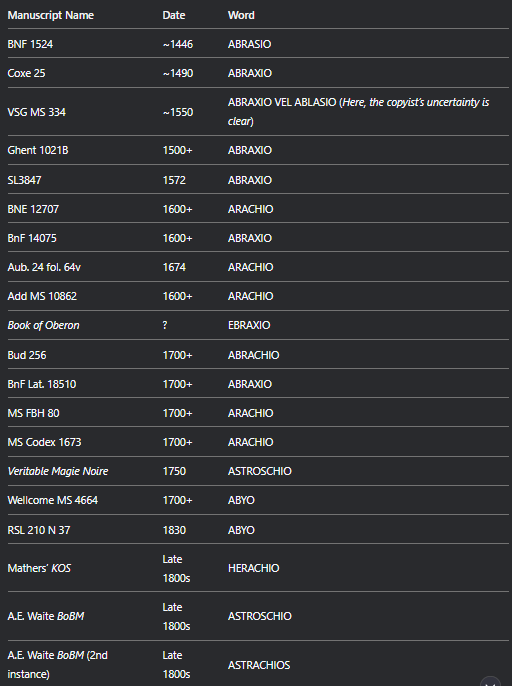
(Fun note: In the Liber Juratus, we find CRASTROSIHOS—wouldn’t it be amusing if this were an ancestor of ASTROSCHIO?)
The point is, these examples show how words transform due to copying errors. The clearest letters—like the initial A (often capitalized) and the final -IO—remain intact into the 19th century. The internal consonants, however, shift predictably.
4) The appeal to their "influence on the psyche" leans too comfortably on the psychological model.
This isn’t to dismiss the psyche’s role in magic. The psyche is always present—just as much when I do magic as when I read a book or share personal stories with loved ones.
But claiming that "barbarous names, being illogical, influence the psyche more" subtly endorses the psychological model—implying that this "advantage" makes magic more effective.
Personally, I believe we need a clean break from these 19th–20th-century remnants. No compromises: either entities have ontological independence, or they’re parts of the psyche. Saying "entities are also in our psyche" is manipulative—everything outside us has an internal reflection. The tree in my garden exists in my memory, evoking sensations, just like my grandparents do. Yet, for those who work with ancestors, it’s clear that memory ≠ essence—we work with ancestors we’ve never even known.
Arguing that words of power "influence the psyche more" implies we grant them power—through suggestion, mystical authority, or belief. Like a dictator’s words hypnotizing an idolizing populace.
What Do I Appreciate About Words of Power?
I personally use them as compressed expressions of concepts. I use OSORONNOPHRIS when invoking Osiris, but only when I’m reasonably sure of its meaning. Otherwise, I avoid them.
I also ignore Iamblichus’ warning "Never alter the Barbarous Names"—he likely didn’t realize they were garbled words or epithets from other languages. Or perhaps he believed they were "hieroglyphs" (sacred writing) to be preserved.
That said, I’m no grammar Nazi—I don’t reject a name over one changed letter. What matters is history. I use names when:
The text explains their meaning ("This name banishes all demons").
A translation is provided ("This is Hermes’ 36-letter name...").
In my experience, magic works perfectly fine without words of power. European folk magic has hundreds of charms using other techniques:
Historiola (narrative magic).
Metaphor ("As Christ suffered not on the cross, so shall you not suffer").
Declarative language ("Leave this body, in the name of St. Peter and St. Paul!").
There are countless techniques where mindlessly parroting PGM gibberish (whose meaning we’ve lost) seems unnecessary. If it works for you, great! But I’ve often sensed a fear of exploration—a blind adherence to "what’s been done" for guaranteed results. Hence why, of the PGM’s hundreds of options, most practitioners stick to the Headless Rite. Results-driven hunger. If X and Y swear by it, it must work. It’s the same mechanism as advertising, no?
What Are the Alternatives?
Beyond historiola and authoritative speech, there’s another simple method—one with ancient roots, described by Plutarch:
"Those who have memorized the names of the Idaean Dactyls use them as charms against fear, reciting each name with calm assurance."
Plutarch was likely referring to the Ephesia Grammata, another "great magical formula" reworked from Orphic texts in Southern Italy—honestly, not very magical. But stripping away assumptions, the core idea is pronouncing the names of the spirits you wish to invoke.
That’s it.
Really.
That’s it.
In folk Catholicism (which influenced countless magical practices in the Americas), repetitive formulas abound:
"St. Peter, protect me. / St. Paul, defend me. / St. Anthony, guard me..."
Or simply the Three Names: "In the name of the Father, the Son, and the Holy Spirit."
Often accompanied by a gesture (crossing oneself, sprinkling water, etc.).
Years ago, working with the Grimorium Verum, I created an alternative to the Astrachios Prayer, replacing the words with spirit names. Below, Jake’s version + some grimoire precedents adaptations (with my substitutions in parentheses):
ASTRACHIOS (SYRACHIOS) – ASACH – ASACRA (SATANACHIA) – BEDRIMULAS (RABIDMADAR) – FILAT (FALCAS) – ANABONAS (ANABOTH) – AMBORACH (SIGAMBACH) – IERAHLEM (TRIMASEL) – ARCHARZEL (AZAZEL) – ZOPHIEL (ZOPHIEL) – PHANUY/BLAUTEL (FLERUTY) – ARUCHATA (AGATERAP) – BARUCHATA (BARACHIN) – ADONAI – ELOY – EMAGRO (MORAIL) – ABRAGATEH (ABRASAX) – ACEDIT (AGLASIS) – GEBURAHEL/BARACH (BECHARD) – SAMANUL (SUSTUGRIEL) – MEL (HAEL) – TADACH (HEPATH) – ERA (HERAMAEL) – ELY (KHIL) – AYA/ACHASH (SYRACH) – ABISERAM/EBMISHA (ASTAROTH) – HUGYMA (HUICTIGARAS) – MACHEA/IMACHADEL (MORAIL) – DAVIT/DANIEL (SIRCHADE) – DAMA (SURGAT) – ELAMOS (FRIMOST) – HYMEL/IZACHEL (TRIMASAEL) – HEL HEL/BAEL (HELHEL[LUCIFER]/BAEL/ORIENS) – HEMON (HUMOTS) – SEGEZ (SEGAL) – GEMAS (GULAND) – JESUS DEUS (AYPERUCH EXBRANOR).
Later, I discarded this version (which retained repetitions for assonance) to free myself from traditionalist constraints. The final version I adopted was:
"In the name of the Gods, the Spirits, and the Holy Ancestors.
In the name of ABRASAX, BARBELO, AYPERUCH, EXBRANOR!
SIGAMBUTH, RABIDMADAR, LUCIFER, BELZEBUTH, ASTAROTH, SYRACH, SATANACHIA, AGATERAP TARCHIMACH, FLERUTY, SERGATANA, NEBIROS, CLAUNTH, RESCHIN, BECHAR, FRIMOTH, KLIO, MERFIEL, GLITHREL, SIRCHAEL, HEPATH, SEGOL, HUMETH, FRULTHIEL, GALAND, SURGATH, MENAIL, FRUTIMIERE, HUICTIGARAS, SERGUTH, HERAMAEL, IRMASIEL, SUFFUGRUEL, HELELOGAPHATEL, HAEL, SERGULAT, FOCULO, HARISTUM, BRUSLEFER, PENTAGNONY, AGLASIS, SIDRAGOSUM, MINOSON, BUCON."
I replaced the Trinity with a triad: Gods, Spirits, and Ancestors.
The Clavicula says: "In nomine Adonay, Tetragrammaton, Ayperuch, Exbranor." I substituted ABRASAX (a word of power tied to the numbers 7 and 365, governing planetary and temporal cycles) and BARBELO (a magical name representing the Divine Feminine).
In the end, I chose the spirits’ names from grimoires by considering their variants and selecting those that were phonetically easier for me to pronounce. For example, between Fruthmierl and Frutimiere, I picked the latter because it rolls off the tongue more smoothly. Other times, I favored names containing certain letters—like R—because they felt more forceful to me.
When I first worked with these spirits, I called them using the variants found in the grimoires, phrasing it like this:
"O thou, Spirit, who art called Fruthmierl, Frutimiere, and Frucissiere across time and ages. Thou who workest to bring forth [state the spirit’s domain], may thou labor with me, in accord and benevolence, to improve my life under Lucifer, Belzebuth, and Astaroth, under Syrach, messenger of the Emperor—just as thou didst for King Solomon in his Temple and Cyprian of Antioch in his endeavors."